Project 03 · Product Design · 2026
Black Meridian
An algorithmic trading platform. A strategy's rules open and close each trade, every market day — on time, and without emotion.
- Role
- Design and development
- Built with
- Python, FastAPI, TimescaleDB, Redis, Next.js, TypeScript, Docker, AWS Lightsail, Grafana, Sentry
- Year
- 2026
- Screens
- Desktop and mobile
- Status
- Live — trading every market day
- Markets
- NSE, BSE and MCX, through Zerodha
Rules over discretion
Manual trading depends on judgement in the moment, and judgement under pressure hesitates, second-guesses and drifts from the plan. A rule set calmly in advance should still hold at 9:15 on a volatile open.
So the trading itself had to be algorithmic: decided in advance, executed without exception.
The platform
Black Meridian watches the live market through Zerodha, runs your strategy on it, and opens and closes positions by its rules. Before any trade opens, it passes fourteen risk checks in under 5 ms.
An order goes to Zerodha only at a price the platform can prove. If it can't prove a price, it doesn't trade.
The whole thing, start to finish
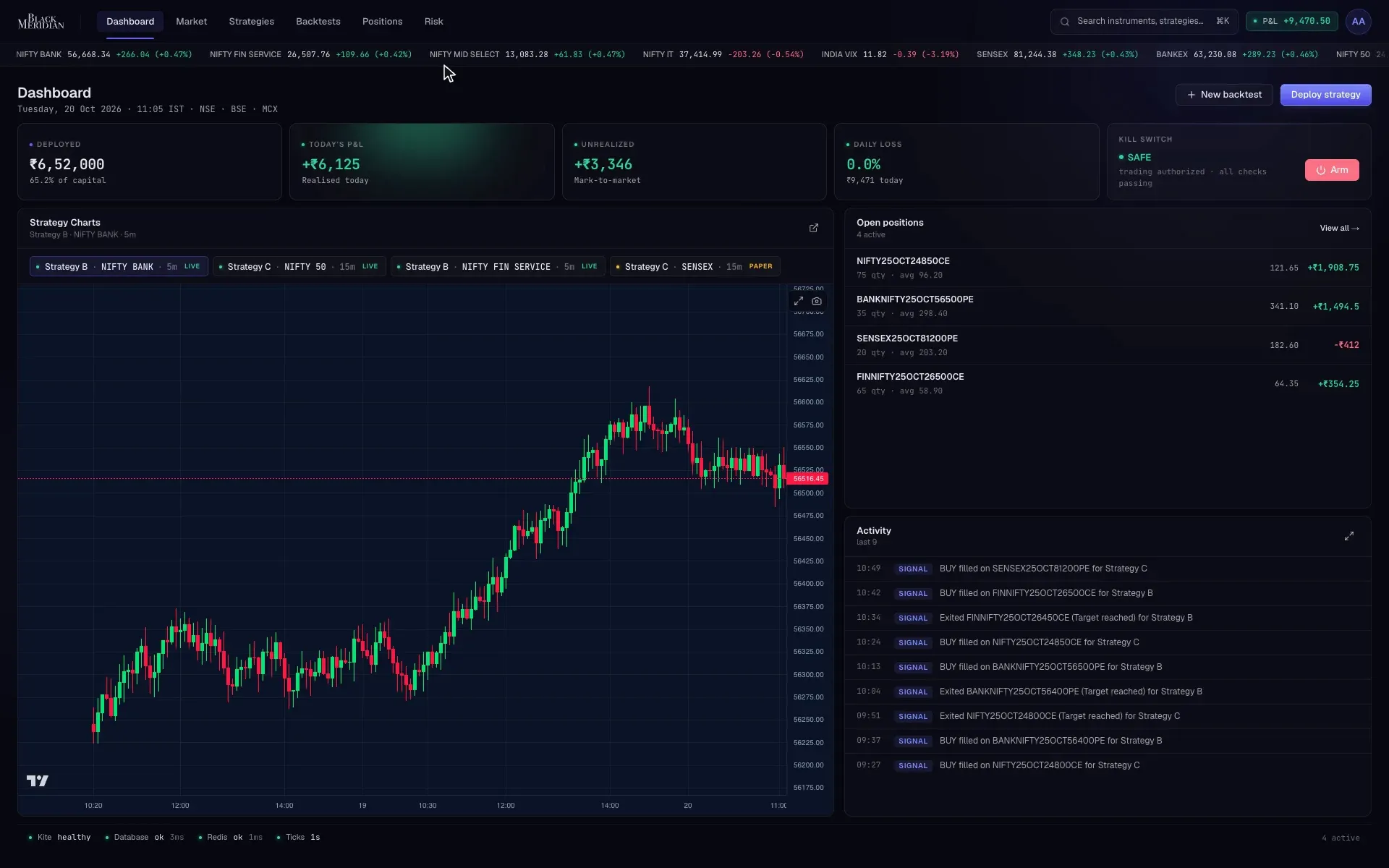
The day at a glance
The dashboard opens on the day so far: five headline figures, a live chart with a switch for each running strategy, the open positions, an activity feed, and a health line for Zerodha, the database and the live prices.
The deployed strategies sit on the strategy charts, one switch each, for a quick look. Nothing stays out of reach — that’s how the dashboard, and the platform behind it, was designed: insight into the market, help with every action, and everything within reach.
From an idea to a running strategy
A strategy starts as an idea — when to enter, when to exit, how much to risk — and becomes a single Python file. Add it to the platform and it gets everything else: live prices, candles in eight timeframes, a settings form of its own, the fourteen risk checks, and a place on every screen.
Deploy it on paper first. It trades the live market in real time and fills at the prices a real order would get, so you see exactly how it behaves before any money is at stake. Tweak its settings, deploy it again and compare, and backtest every version on the same history until it performs at its best. When a version has earned it, switch it to live money; nothing else about it changes.
Several strategies run side by side, each with its own capital, its own limits and its own record of every decision — the strategies page keeps their returns, their runs and their open positions in one view.
Risk you can see
Every entry passes fourteen checks in order, and the first no wins. A check that breaks counts as a no. Exits are never blocked, so a limit can't trap you in a position.
The risk page shows the state, every limit as it fills, the trades it stopped, and the kill switch. When the switch can't be released yet, the button says why — in the server's own words, from the same rule the release runs.
Backtests that show their working
Backtest any strategy on the platform’s own instrument data. The history is already on board — Zerodha’s, and every option price the archive has saved — so a strategy can be tested, tuned and tested again before it trades, keeping what makes money and cutting what loses it.
Each run is honest about its evidence. Before it starts, it says how many days it has real prices for; afterwards, every fill shows where its price came from. The share of real prices is rounded down, so a result never looks better than the data behind it.
Built to run every day
Black Meridian runs on AWS Lightsail, close to the exchanges, as ten Docker containers behind Cloudflare: the platform, its database, Redis, the web server and the monitoring around them.
Grafana watches all of it — from trading and the broker to every background job’s heartbeat. Sentry catches errors on the server and in the browser as they happen, with keys and tokens scrubbed before anything leaves. New work ships at 06:30, before the market opens, through a deploy that rolls itself back if a step fails, and every Sunday the price archive’s backup is restored to prove it still works.
Next project · 01
Portfolio-OS All work (3)